
Identity area
Reference code
Title
Date(s)
- 1894 - 2020 (Creation)
Level of description
Extent and medium
120 boxes plus journals, 23 linear metres
Context area
Name of creator
Administrative history
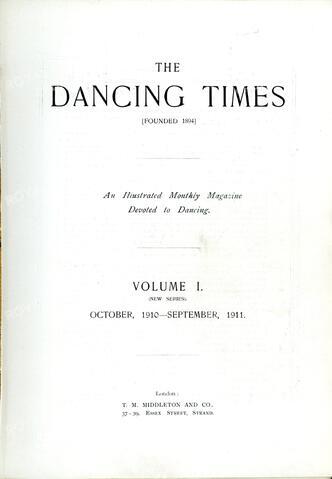
The Dancing Times, first published in 1894 as the house magazine of the Cavendish Rooms, London, a ballroom dancing establishment, was the oldest monthly devoted to dancing. It was bought in 1910 by P. J. S. Richardson and T. M. Middleton and transformed into a national periodical, covering all forms of dancing, and reporting worldwide. Richardson was a British writer on dancing and was the editor of the Dancing Times from 1910 until 1958 when he was succeeded by A H Franks, but remained president until his death in 1963. Franks split off the ballroom section of the magazine into a second periodical, the Ballroom Dancing Times, and in 1962 doubled the format of the Dancing Times to its present size of A4. Franks died suddenly in 1963 and Mary Clarke, then assistant editor, became editor. In 2015 the ballroom and social dance magazine, by then given the title Dance Today, was reintegrated into the pages of the Dancing Times so that the magazine again covered all aspects of dance. Clarke retired from the editorship in 2008 and was succeeded by Jonathan Gray who continued its original stated policy to maintain the highest standards of criticism and illustration, give voice to leading authorities, encourage high standards of teaching, encourage awareness of dance history and stress the importance of dance in education.
For more than 110 years Dancing Times remained the leader in its field, sustained by loyal readers and advertisers alike. Unfortunately changing financial conditions, the global pandemic of 2020, and changing patterns of readership led to the magazine closing, and the final issue of the Dancing Times was published in September 2022. During its years of publication, the Dancing Times amassed a collection of photographic images representing all the aspects of dance covered by the magazine. Some of the earlier material was lost during World War II, but a significant library remains. Due to the breadth of coverage, the image library constitutes an important and valuable academic and historical resource, offering a range of images unlikely to be found in any existing single image collection.
Repository
Archival history
Immediate source of acquisition or transfer
Content and structure area
Scope and content
The bulk of the collection comprises the photographic archive of 35,000-40,000 images. The images reflect the growth of dance from relatively sparse coverage in the years before 1914, rising in the 1920s and 1930s, growing exponentially in the 1940s and throughout the years of the “ballet boom” in the late 1940s and 1950s. They trace the expansion of contemporary dance in the US and the UK (especially London Contemporary Dance Theatre) during the 1960s and 1970s and the growing popularity of national dance, especially Spanish and Indian. The diversity is one of the collection’s strengths, charting the rise of first the national dance companies, and the rise of contemporary Black and Asian dance. The Dancing Times magazine was noted for its international coverage and this is reflected in the images of the flourishing dance scene in Europe, the US, the Soviet Union and further afield.
Additional material includes a complete run of the Dancing Times magazine from 1894 - 2020; Ballroom Dancing Times; and Dance Today, along with some framed photographs, historical designs and visitor books.